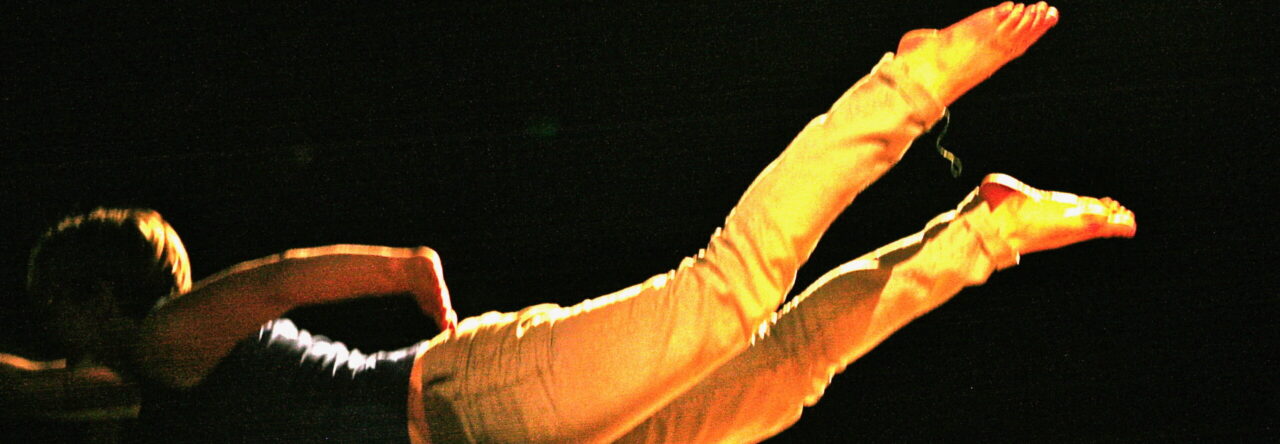
A movement response can be a singular gestural idea, but is richer if you find at least a 3-part action movement response.
For Example: The word is “birthday”, I wrap my arms around myself like a hug, then bring my arms overhead like taking a sweater off, cup my palms together, then blow across the palms and let the palms open, my focus looks forward as if following the breath move away from me while jumping up and down.
I have been creating “text + movement” solos for over thirty years. Here are some of the methods I use to find the movement for words, so as to not “pantomime” but rather embody, or find abstract connections to uncover subtextual layers of meaning. These examples are for single words.
- Where does the word “land” in your body? Form that place where does it move, and how does it move? Follow that as an action. Consider this as at least a 3- part gestural idea.
- “Spell it”: “write” the selected word in space, on your body, on the floor or a wall or a prop. Use different body parts to do the writing.
- “Meaning”: Look the word up in a dictionary and create movement from the meaning of the word, with the specificity of a dictionary definition. We think we know what a word means, but a dictionary provides a more succinct understanding.
- “Redundancy”: Example – the word is “sun”, I make a big circle overhead. The word is “rain”, I make imitation raindrops falling from the sky. Be careful with redundancy. Use sparingly.
- “Counter redundancy”: Example: the word is “yes”, I shake my head “no”
- “Sound”: Allow the sound of the word to shape the kind of movement you make
- “Puns”: Example the word is “I” I might point to my “eye”.
- Imagination connections”: The word suggests something to me, that I may not be able to define, but it just feels that way. Go with it.
- Memory Connection: You have a memory of something associated with this word. Use that as your inspiration to create the movement.
- “Details”: Example: the word is “dock”, I recall a dock and focus in on how the water laps at the pilings. Or the texture of the rough wood, or the chipping paint on the post used to tie up a boat.
WHEN CREATING MOVEMENT FROM TEXT THE IDEA IS TO FIND SUBTEXT FOR THE AUDIENCE. THIS IS NOT CHARADES. THIS IS A WAY TO USE SPOKEN WORD AND MOVEMENT IN TANDEM WITH ONE ANOTHER. The audience is not expected to “guess” what the movement means, but rather the movement creates an evocation of an idea.
“The text is subtext to the movement, and the movement is subtext to the text.” – Celeste Miller